Baking Soda For Weight Loss: The Viral Kitchen Secret Explained

Medical Disclaimer
This article is for informational purposes only and does not constitute medical advice. Always consult with a qualified healthcare provider before making changes to your health regimen, especially if you have underlying health conditions.

You are at the meat counter, doing the arithmetic in your head. The tender cut is fourteen dollars a pound. Beside it sits the cheap one, three or four dollars — but you have tried that one before. Gray. Chewy. Tough as a work boot. So you pay the fourteen dollars, and you tell yourself that is just how it is.
Let me say it plainly. That is not how it is. The cheap cut was never the problem. What was missing was a little knowledge — and that knowledge costs nothing at all.
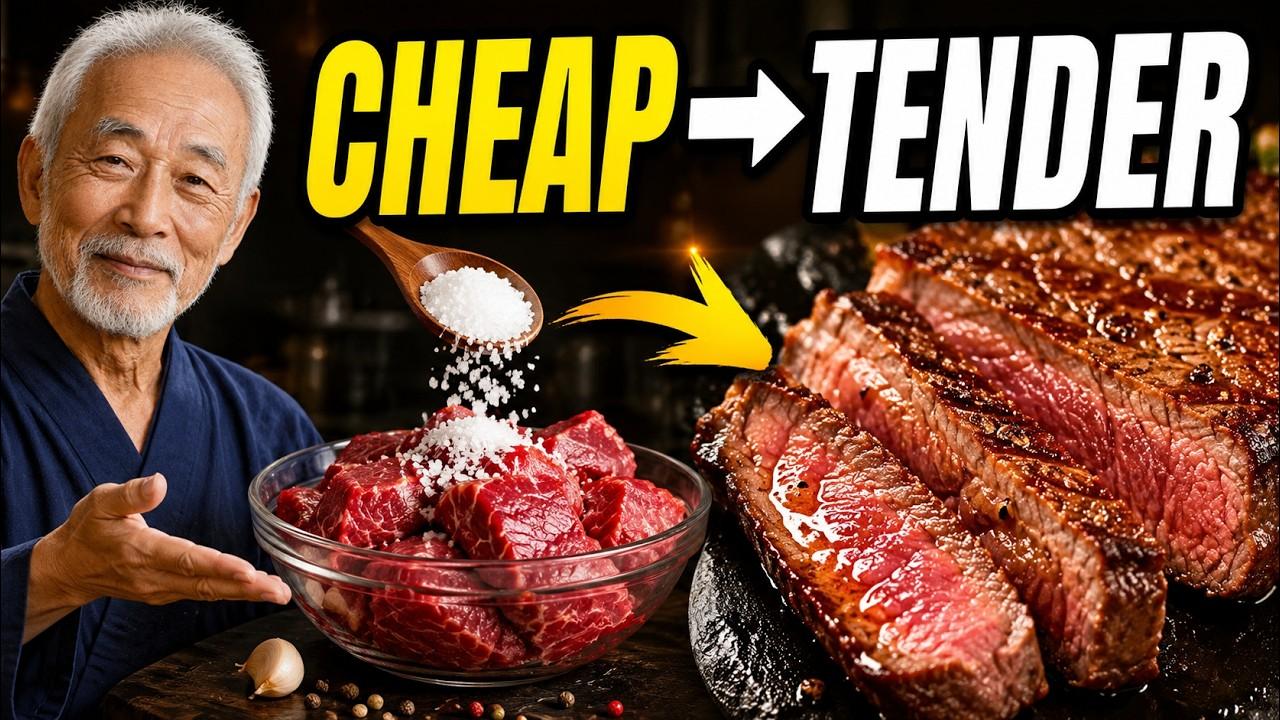
At 81 years old, in my kitchen here in Okinawa, my wife Yuki takes that same three-dollar cut, rubs one ordinary thing into it, lets it rest a few minutes, and cooks up beef so tender you could cut it with the side of a chopstick. The same animal. The same cheap cut. A tenderness that eats like the fourteen-dollar meat — for a fraction of the price.
In Japan, and across much of Asia, cooks have known how to soften cheap meat for centuries. Not with costly gadgets. With plain things already in your kitchen, and a little understanding of what meat actually is.
In this video I’ll show you the real science of what makes meat tough — the fibers, the collagen — and then, step by step, several honest ways to make cheap beef tender: slicing across the grain, the baking-soda velveting used in Chinese restaurant kitchens, and the fruit marinades behind Korean bulgogi. You’ll get the exact amounts and timings, the mistakes that ruin it, the plain food-safety rules you must follow, and the real money you’ll save in a year.
We have a word for the sorrow of waste: Mottainai. And there is real waste in fearing good, cheap meat and cooking it wrong. Today, that ends.
Sit down. Take your time. Let’s make something real together.
Why the cheap cut was never the problem · What actually makes meat tough (fibers + collagen) · Slicing thin across the grain · The baking-soda velveting trick (and how not to ruin it) · Fruit marinades: kiwi, pineapple, pear (bulgogi’s secret) · Fast heat vs. slow braising · The food-safety rules that matter · The honest cost math

Stacy Bates, MS, RDN
Registered Dietitian, Published Author, Sports Nutritionist
Founder of SPAN Athletics • Texas • 20+ years experience
View full profile | Aspen Institute Fellow
Stacy Bates, MS, RDN is known for a practical, real-world approach to nutrition counseling that meets people where they are. She helps clients translate science-backed strategies into sustainable habits, avoiding rigid rules and emphasizing progress over perfection. Learn more about her evidence-based philosophy at Nourish.
